
About the Study
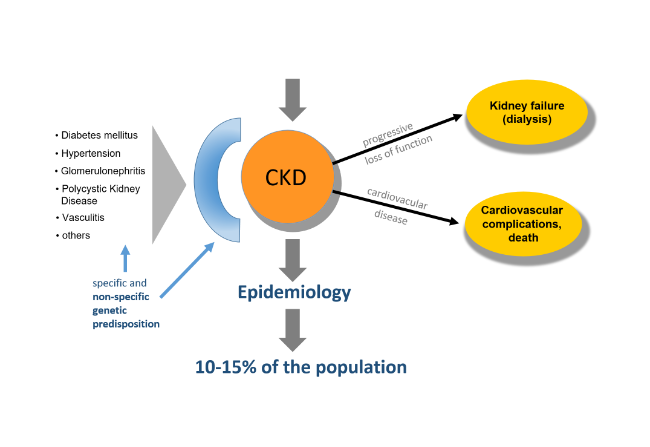
Chronic kidney disease (CKD) affects 10–15% of the population and represents a growing challenge for healthcare systems worldwide. The various underlying conditions that lead to kidney failure, as well as their consequences and prognoses, differ considerably. Patients face competing risks: on the one hand, progression of kidney disease to end-stage kidney failure requiring kidney replacement therapy; on the other hand, cardiovascular complications and increased mortality.
The GCKD study investigates these relationships to gain a better understanding of disease progression and risk factors, thereby providing a foundation for improved prevention and treatment strategies.
GCKD in Numbers
- 11
- participating
universities
- 150
- participating
nephrologists
- 5217
- patients included
in the cohort
- 16
- years of follow up
Study Design
The GCKD study is designed as a multicenter, non-interventional, prospective observational study. The medical care of the patients is not to be influenced by the study. All regular therapies of the patients will be recorded without changing or influencing them. Decisions about diagnostics and therapy are the responsibility of the patient and his treating nephrologist or general practitioner.
Study participants
More than 5,000 patients were recruited throughout Germany between 2010 and 2012.
- Age: 18-74 years,
- eGFR between 30 and 60 ml/min/1,73 m^2 and / or
- albuminuria >300 mg/g creatinine
- Non-Caucasian race
- Solid organ transplantation or bone marrow transplantation
- Active malignancy within 24 months prior to screening
- Patients under legal attendance or unwilling to provide consent
Timeline
Baseline (2010 – 2012): In-person study visit including collection of biological samples
FU1 (2011 – 2013): Telephone interview
FU2 (2012 – 2014): In-person study visit including collection of biological samples
FU3 (2013 – 2015): Telephone interview
FU4 (2014 – 2016): In-person study visit including collection of biological samples
FU5 (2015 – 2017): Telephone interview
FU6 (2016 -2018): In-person study visit including collection of biological samples
FU7 (2017 -2019): Telephone interview
FU8 (2018 – 2020): Telephone interview
FU9 (2019 – 2021): Telephone interview
FU10 (2020 – 2022): Telephone interview
FU11 (2021 – 2023): In-person study visit including collection of biological samples
FU12 (2022 – 2024): Telephone interview or study-site visit, if no visit was conducted at FU11.
FU13 (2023 – 2025): Telephone interview
FU14 (2024 – 2026): Telephone interview
FU15 (2025 – 2027): phone interview
FU16 (2026 – 2028): Telephone interview